Do Coffee Grounds Help Big Daddy Hydrangea? Myth vs Fact
Walk a border in July and you will see it: the same mophead drifting blue in one yard and rose pink in the next, with the neighbors swearing the difference comes from the kitchen. Coffee grounds, a splash of vinegar, a banana peel buried at the roots. The common belief is that pantry scraps steer the color.
What we see instead is that most of those rituals do very little, and a few quietly work against the shade you want. Color on a bigleaf mophead like Big Daddy comes down to soil chemistry, and the kitchen is a weak lever on it. Get it wrong and you spend a season waiting for blooms that open in a color you did not plan. Read on for how coffee grounds, vinegar, scraps and all-purpose feed behave, why pink is no sign of trouble, and the one amendment that reliably moves the color.
Coffee Grounds Will Turn Big Daddy Hydrangea Blue
This is the belief we hear most, and it rests on a tidy chain of thought: coffee is acidic, blue flowers want acid soil, so grounds should do the job. The first link in that chain is where it breaks.
What Brewed Grounds Do to Soil pH
The numbers settle this quickly, so we put them side by side.
Oregon State Extension calls it a common misconception that grounds are acidic. After brewing, they are close to neutral, around pH 6.5 to 6.8. Virginia Tech says flowers turn blue in a relatively acid soil of about pH 5.0 to 5.5. Brewed grounds land a full point or more above that range, in the territory where a mophead turns purple or pink.
Scale works against the ritual too. A bigleaf hydrangea can spread 3 to 6 feet across at maturity, and its roots run through a large volume of soil. A cup of grounds at the base barely registers.
Why the Color Rarely Changes
Even a perfect acidifier would only be half the story, because the pigment needs a second ingredient.
As the University of Georgia explains, soil pH indirectly affects flower color by affecting the availability of aluminum. Blue heads form when the roots can take up aluminum. Grounds supply neither a meaningful drop in pH nor any aluminum, so the head keeps whatever color your soil was already giving it.
One of the most common questions we get is whether a daily coffee habit can stand in for soil work. It cannot. Grounds are fine worked into compost or scattered in a thin layer, and they do no harm to the shrub. Just do not count on them for color, and do not pile them thick, where a wet mat can shed water instead of passing it down. For what your soil actually needs, see our guide to the best soil for Big Daddy hydrangea and how to amend it.
Vinegar in the Watering Can Shifts Color Overnight
Vinegar feels more convincing than grounds because it really is acidic. The trouble is what happens after it leaves the can.
A Quick Dip That Does Not Last
Vinegar does lower the pH of the soil it touches, but only briefly.
Soil resists change, and it pulls a splash of weak acid back toward where it started within days. Rain and irrigation carry it down past the roots, and soil microbes consume it. You get a short dip in pH followed by a return to normal, which is no way to hold a bloom in the blue range through the weeks when the flowers are developing. Virginia Tech notes that flowers are mostly produced in June and July, so there is a real season to hold the pH through, not a single evening.
Why Nothing Happens Overnight
The idea of a color shift overnight misreads how the plant works.
Color follows what the roots take up while the flowers develop, not what you pour on an open head. A bloom that has already opened in pink will not turn blue because of a treatment that evening. Repeated vinegar dosing also risks stressing the fine roots that shallow-rooted hydrangeas depend on, and that stress shows up as wilting you then mistake for thirst.
If you want a lasting drop in pH, the material that does it is sulfur. Mississippi State Extension says to use lime to increase soil pH or use sulfur to decrease soil pH. Sulfur works slowly, which is exactly why it lasts. Save the watering can for plain water, and read our watering guide for how much.
Eggshells and Banana Peels Feed Big Daddy Hydrangea
Scrap feeding has an appealing logic: the plant gets something back from the kitchen. Looking at what each scrap holds, and what color needs, takes the shine off it.
Eggshells Lean Toward Pink
Eggshells are mostly calcium carbonate, which is chemically a close relative of the lime used to raise soil pH.
Whole shells break down over many months, so the effect is slow and small. But the direction matters. If you are growing Big Daddy for blue heads, a material that leans toward alkaline is the wrong way to go. If you like pink, eggshells will not hurt, though they are a very weak substitute for lime. Either way, they add no aluminum, the ingredient blue depends on.
We often see eggshells in a ring around a stem a full year later, still whole and pale, looking like small white confetti. They are tidier in the compost bin.
Banana Peels Add Little
Peels are soft and rot down quickly, which is the best thing about them.
Buried at the roots, they release a small amount of nutrients as they decompose, nothing a shrub can't get from a balanced feed or a layer of finished compost. They are not an acidifier, they carry no aluminum, and they have no known role in moving a bloom between blue and pink. We would compost them first and spread the compost afterward. That way you get the soil benefit without the fruit flies hovering around your border in July.
The honest summary for scraps is that they are harmless to mediocre, and color is not among their effects. Our fertilizing guide covers what to feed instead.
Miracle-Gro Alone Won't Recolor Big Daddy Hydrangea
Readers ask us whether they can use Miracle-Gro on hydrangeas, and the answer is yes, with a catch about what it will and will not do for color.
Reading the Label for Phosphorus
Every bag or bottle of all-purpose feed shows three numbers, and the middle one is phosphorus.
That middle number matters because phosphate and aluminum pull against each other. If you want blue and purple blooms, use a fertilizer that is low in phosphate, since phosphate limits the plant's ability to absorb aluminum. A feed with a generous middle number can therefore hold a mophead back from blue even when your soil is acidic enough.
Nitrogen Builds Leaves, Not Hue
Nitrogen is the first number, and it drives green growth, stems and leaf size.
It does not decide whether a head is blue or pink. The sources we trust tie color to soil pH, aluminum and phosphate, not nitrogen. A heavy hand with any all-purpose feed pushes leafy growth, which is lovely against a pale border wall in June, but it will not change the shade of the flowers.
Which Feed We Would Choose
Here is where we land, and for whom.
If you want pink, or you do not care, an all-purpose feed used at the label rate is fine. If you want blue, choose a feed with a low middle number and pair it with an aluminum and pH plan. Whichever you pick, follow the label rate and do not double up, because overfeeding burns roots faster than it grows flowers.
Pink Heads Mean Big Daddy Hydrangea Is Struggling
Customers sometimes send us photos of pink heads asking what went wrong. Usually nothing did.
What Pink Actually Tells You
Pink is a chemistry report, not a health report.
NC State puts it plainly: blue flowers develop with acidic soil and pink flowers in alkaline soil. In between, UMass Extension notes that from pH 5.5 to 6.5 the flowers will be purple, or a mixture of blue and pink on the same plant. A shrub with pink heads and glossy, deep green leaves is a healthy shrub growing in a soil where aluminum is locked up.
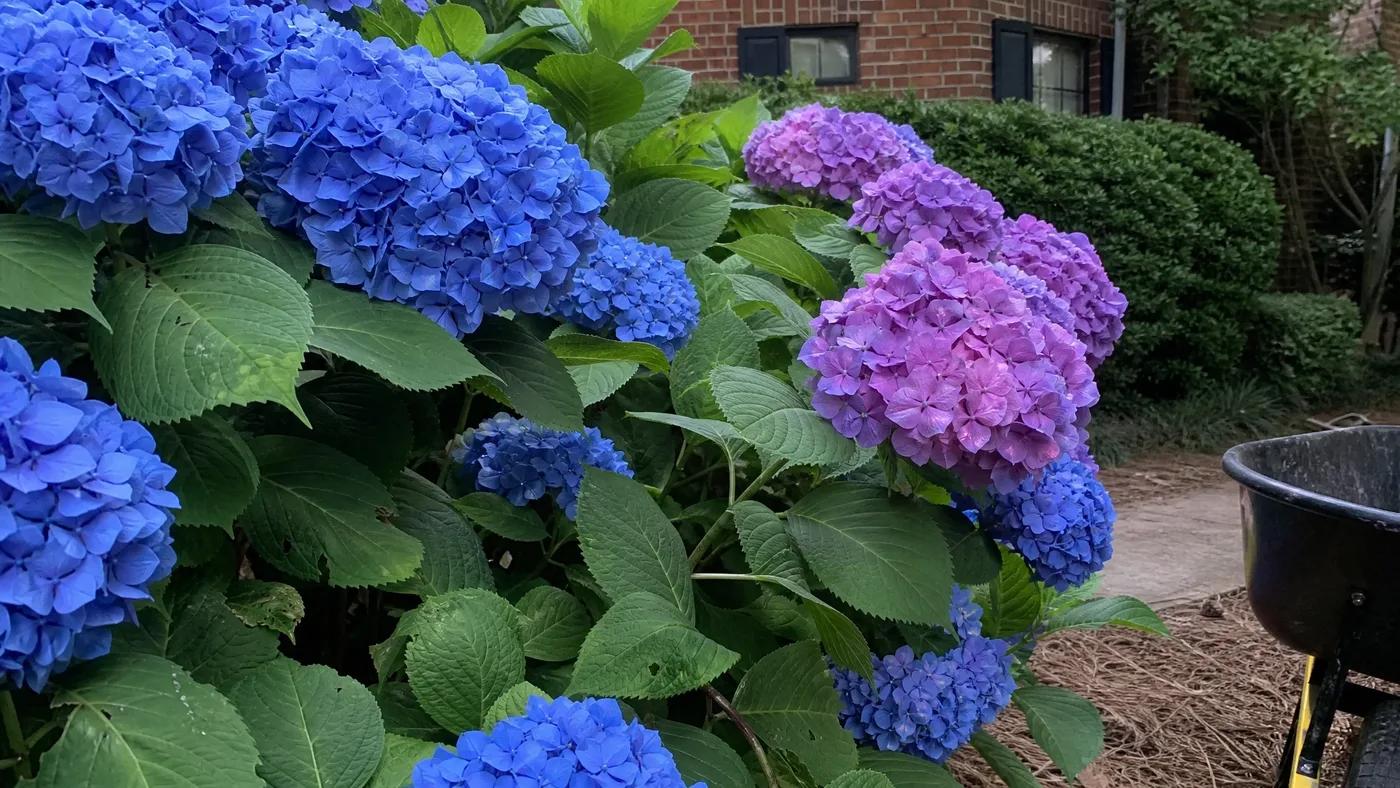
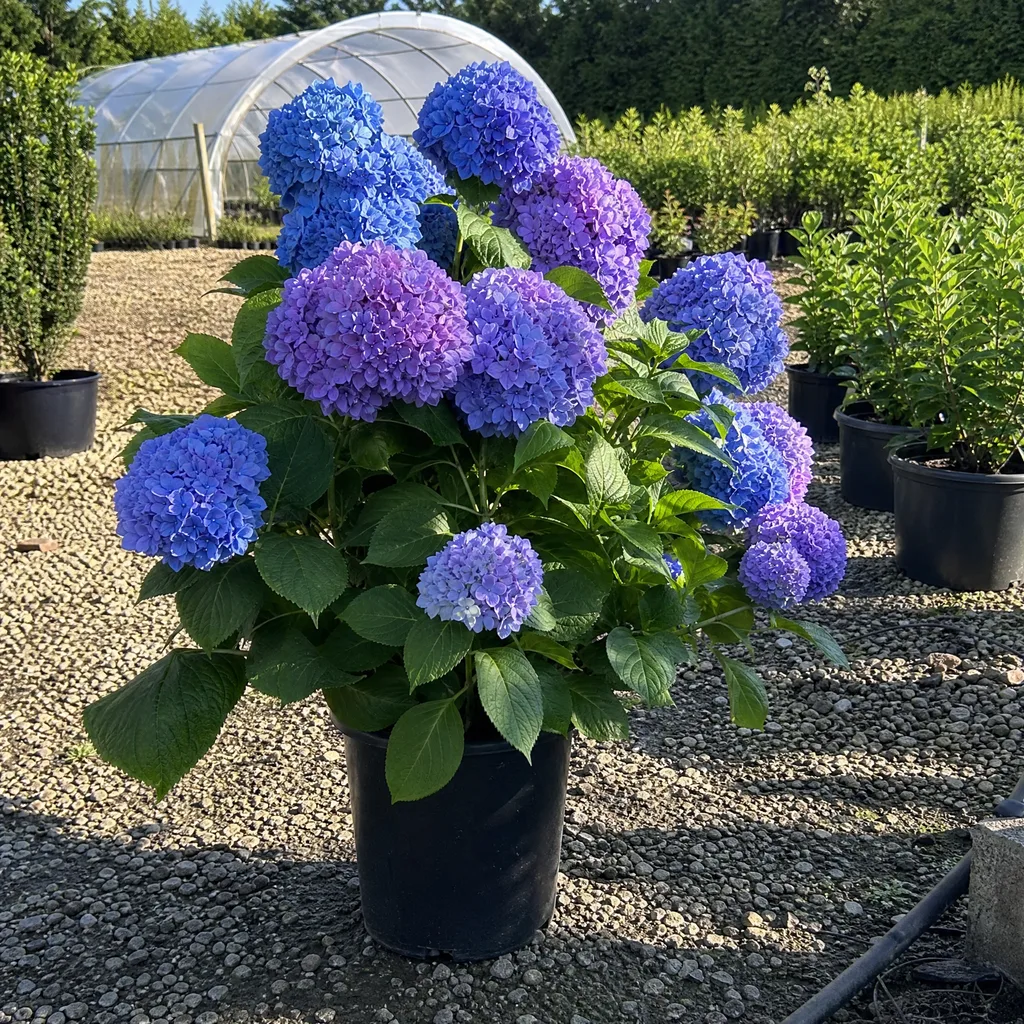
Mixed heads are normal too. A mophead with blue at the center and pink at the edges is simply sitting at the middle of the range.
Pink as a Design Choice
From a designer's seat, pink is not a consolation prize.
It reads warm against fresh green foliage and picks up the pinks in nearby perennials, while blue cools a shady corner. If your soil already runs near neutral or above, pink is the low-effort path, and fighting it every year costs more than it gives back. Our guide to Big Daddy hydrangea bloom color goes deeper on choosing.
Warning Signs Worth Acting On
Real trouble shows in the plant, not in the shade of the petals.
Look for wilting that does not recover by morning, leaves that yellow or scorch, or blooms that fail to appear at all. Those point to water, light or pruning, and our guide to common problems sorts them out. A change in flower color is not on that list.
Only Aluminum Sulfate Really Moves the Color
If you want to change the shade, you need an amendment that works on the actual mechanism, which means aluminum and pH.
Rates That Extension Services Give
These are the figures that come from university sources, not from a neighbor's habit.
To make the flowers turn blue, the University of Georgia says to dissolve 1 tablespoon of aluminum sulfate in 1 gallon of water and apply it to the soil. To go pink, broadcast 1 cup of dolomitic lime per 10 square feet and water it in. Sulfur is the slower, longer-lasting route to a lower pH, and Mississippi State Extension gives fall rates, so check their page or your local extension service for your soil.
Timing and Restraint
Because this shrub blooms on the previous year's growth, color is shaped over a long run, not in a single week.
Treat the soil in the weeks before and during bud development, repeat only as your soil test supports, and never exceed the stated rate. More aluminum sulfate does not mean bluer blooms. It means stressed roots. Expect the shift to take a full season, and more if your soil is strongly alkaline.
The Whole Field in One Table
This table sets every material we covered against what it really does.
| Material | What it really does | Our verdict |
|---|---|---|
| Coffee grounds | Near neutral after brewing, barely moves pH | Compost them, skip for color |
| Vinegar | Brief dip that soil absorbs | Skip |
| Eggshells | Slow, calcium-based, leans alkaline | Compost, skip for blue |
| Banana peels | Small nutrients, no aluminum | Compost |
| All-purpose feed | Feeds growth, phosphate may block aluminum | Fine for pink, wrong for blue |
| Aluminum sulfate | Supplies aluminum and lowers pH | The choice for blue |
| Sulfur | Lowers pH slowly and lastingly | Good partner for blue |
| Dolomitic lime | Raises pH | The choice for pink |
Where the Color Lever Actually Sits
Color on Big Daddy sits in the soil, in two places: the pH and the aluminum available to the roots, with phosphate in feed as a third influence. Coffee grounds, vinegar, eggshells and banana peels are kitchen folklore for this purpose, and an all-purpose feed won't recolor a head on its own. Pink is a result, not a symptom. Aluminum sulfate, sulfur and lime are the materials that actually work.
Big Daddy Hydrangea
Nursery-grown Big Daddy Hydrangea in sizes from 3 Gallon, shipped to your door.
From $65.85
Shop Now →Picture the border in full bloom, great rounded heads in blue or rose lifting over deep green leaves, and then picture getting there with a test kit instead of a coffee pot. Test the soil before reaching for any pantry fix, and let the number tell you which way to go. Our own farms raise the Big Daddy shrubs we sell, and we stand behind straight answers about them. Customers come back to us for those big, generous heads and for honest advice on getting the color they want.