Fertilizing Big Daddy Hydrangea: What, When and How Much
"Do I really need to feed my Big Daddy?" is the question customers ask us most. Our answer is yes, but lightly, and mostly just once in early spring. Those heavy mopheads that open in early summer are built on what the roots take up in March and April.
Feed too much and you get lush leaves and few blooms. Skip feeding in poor soil and the flowers come small and the leaves pale. This article talks about fertilizing Big Daddy Hydrangea and answers the questions customers ask us most. Read on to learn which products to choose, when to apply them in the plant's first years, how to measure and spread them, and how fertilizer and aluminum sulfate change bloom color.
Why Fertilize Big Daddy Hydrangea?
Big Daddy Hydrangea naturally wants rich, humusy soil with good organic matter. In established landscapes, especially sandy or clay-heavy soils, a light annual feeding provides the nutrients the shrub needs to:
- Produce abundant, full mophead flower clusters
- Develop healthy, glossy dark green foliage
- Support steady growth toward a mature size of up to 6 feet tall and wide
- Maintain vigor in the face of regular watering demands
Here is how the first years go. Do not fertilize at planting. Mix compost into the backfill instead, as we describe in our soil guide, and let the new roots settle for a season. Start feeding the first spring after planting, using half the rate on the label.
The key word here is "light feeding." Big Daddy Hydrangea is not a heavy feeder, and over-fertilizing can lead to excessive vegetative growth at the expense of blooms. A modest, well-timed application in early spring is the heart of good fertility management.
Best Fertilizers for Big Daddy Hydrangea
Several fertilizer types work well for Big Daddy Hydrangea. Choose based on your goals and your soil pH.
Balanced or Hydrangea-Specific Fertilizer
A balanced fertilizer (such as 10-10-10 or 5-5-5) applied in early spring provides nitrogen for leaf growth, phosphorus for root development, and potassium for overall plant vigor. Alternatively, hydrangea-specific fertilizers are formulated to support flower production and are often slightly higher in phosphorus and potassium relative to nitrogen. These products are widely available at nurseries and garden centers in granular, liquid, or time-release forms.
A common tip is to use a high-phosphorus "bloom booster" on hydrangeas. We don't follow it. In our rows a balanced product does the job, and extra phosphorus just builds up in the soil without making more flowers.
Aluminum Sulfate (Alum)
If you want to encourage or maintain blue blooms, aluminum sulfate (sometimes called alum) is the tool. This product lowers soil pH and increases aluminum availability to the plant. Blue Big Daddy flowers depend on an acidic soil environment (pH around 5.5 or below) and the plant's ability to absorb aluminum. Aluminum sulfate typically comes as a dry powder that you dissolve in water and apply around the base of the plant during the growing season.
Garden Lime (Calcium Carbonate)
To encourage pink blooms, garden lime raises soil pH and reduces aluminum availability. Lime works more slowly than aluminum sulfate and is best applied in fall or early winter if you plan a pH shift. It is not typically used as a spring fertilizer in the same way that balanced products are.
When to Fertilize Big Daddy Hydrangea
Timing matters most with Big Daddy. It blooms on the previous year's growth, so flower buds form in late summer and fall and open the following early summer. It is hardy in zones 6 to 9, and the exact bloom dates shift with your region. Fertilizing at the wrong time can waste product or disrupt bud development.
Spring Application: The Main Feeding
Apply a balanced or hydrangea-specific fertilizer in early spring, when new growth emerges and the plant is actively leafing out. In most zones 6 to 9, this falls between late March and mid-April. This single spring application provides the nitrogen and other nutrients the plant needs to support foliage and flower bud maturation over the upcoming months.
Summer Maintenance (Optional)
A light secondary feeding is sometimes beneficial in early summer (June), particularly if the plant is in a container or in sandy soil that drains quickly and may be nutrient-depleted. This second dose can support continued flowering and foliage quality. However, avoid fertilizing after mid-July, as late feeding can stimulate tender new growth that may not harden before winter.
We often see customers feed in August hoping for a second round of blooms. Don't. The buds for next year are already set by then, and all you get is soft growth that winter will burn.
Aluminum Sulfate Timing
If you apply aluminum sulfate to shift or maintain blue bloom color, begin applications in late spring or early summer (May or June) and continue every 4 to 6 weeks through August. The effects are gradual, so expect results to appear over the course of the season and to intensify the following year if applications are continued.
How to Fertilize Big Daddy Hydrangea: Step-by-Step
Match the method to the product you chose. Granular feed is our pick for the main spring dose, while liquid and aluminum sulfate each have their own routine.
For Granular Fertilizer (Spring Application)
Use these steps for the early spring feeding, once the first leaves have opened.
- Water the plant thoroughly the day before fertilizing. Moist soil helps the plant absorb nutrients and reduces the risk of fertilizer burn on the roots. Big Daddy Hydrangea wants consistently moist soil, so this step also aligns with good watering practice.
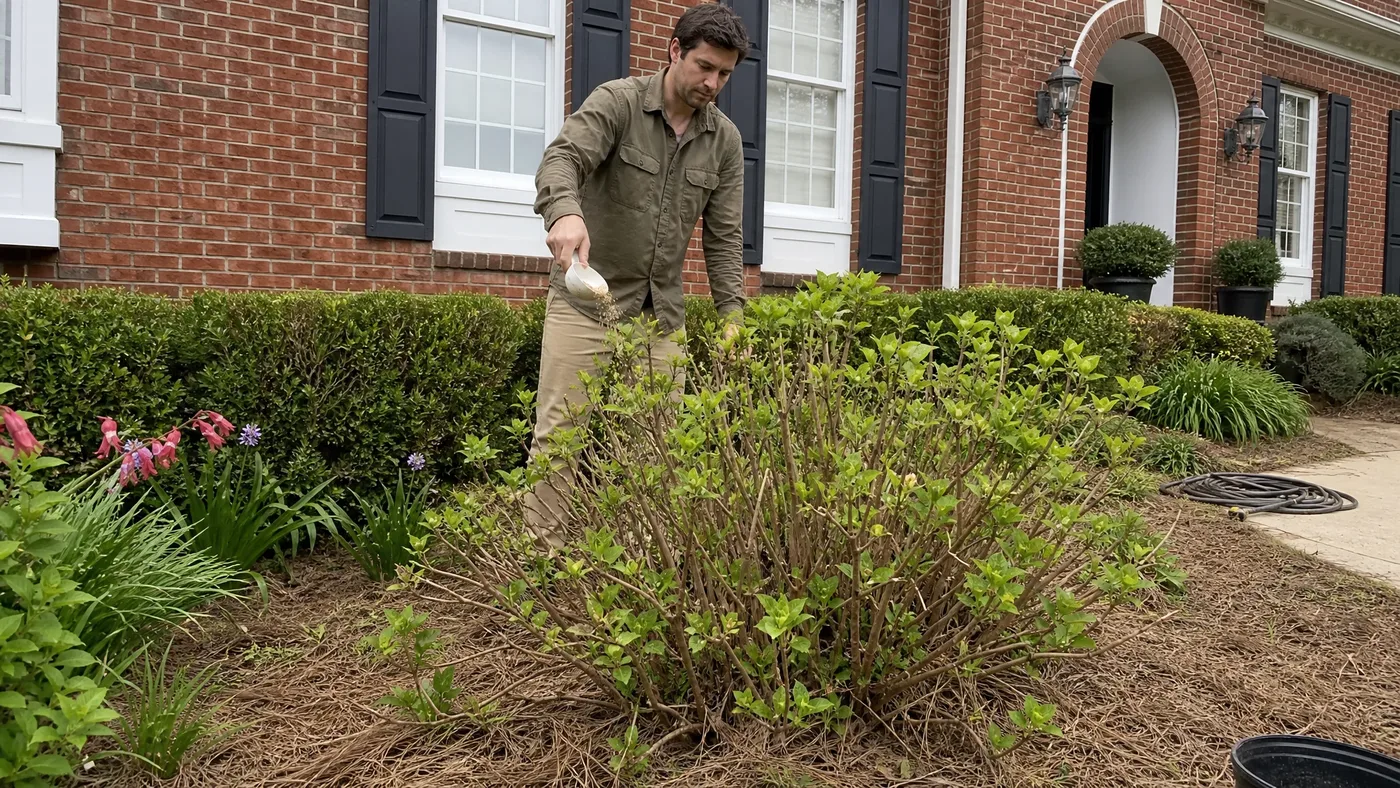
- Measure the fertilizer according to label directions. Granular fertilizers are typically applied at a rate of 1 to 2 tablespoons per foot of plant height, or as directed by the product label. For a mature Big Daddy Hydrangea reaching 5 to 6 feet, this might be roughly 5 to 10 tablespoons (or about 1/3 to 2/3 cup), depending on the fertilizer formulation and soil condition.
- Scatter the granules in a circle around the base, staying 6 inches away from the stems. Create a circle that extends from near the drip line (the outer edge of the canopy) inward, but avoid piling fertilizer against the woody stems, which can cause damage or rot.
- Lightly work the granules into the top layer of soil with a hand cultivator or rake. Gently scratch the surface to incorporate the product into the top 1 to 2 inches of soil. Do not dig deeply or turn over the soil, as Big Daddy Hydrangea is a shallow-rooted shrub and aggressive cultivation can damage roots.
- Water thoroughly after application. Water the area well to dissolve the granules and carry nutrients into the root zone. Follow up with a 2 to 3 inch layer of mulch (such as shredded bark) if you have not already done so. Mulch helps retain moisture and moderates soil temperature, both of which support nutrient uptake.
For Liquid or Dilutable Fertilizer
Liquid feed suits a June top-up or a potted plant. Follow these steps so the roots get the benefit.
- Mix the fertilizer concentrate according to label instructions. Liquid fertilizers often require dilution in water. Follow the product label carefully for the correct ratio.
- Water the plant thoroughly the day before or water it first before applying the liquid fertilizer. Do not apply diluted fertilizer to dry soil.
- Apply the solution in a wide circle around the base, extending to the drip line. Pour slowly and evenly so the liquid soaks into the soil rather than running off. Use a soaker hose or drip irrigation if available, as these methods deliver nutrients directly to the root zone and minimize leaf wetting.
- Water again lightly after application to help settle the nutrients and ensure they reach the active roots below.
For Aluminum Sulfate (Blue Bloom Enhancement)
Use aluminum sulfate only if you want blue flowers. Work through these steps in order, starting with a pH check.
- Test or assume your soil pH. Aluminum sulfate works best in already-acidic soil. If you have not tested soil pH recently, assume it is roughly neutral to slightly acidic in most landscapes. A soil test kit or lab test will give you a baseline. Targeting pH 5.5 or below will support blue blooms.
- Dissolve aluminum sulfate in water according to product label rates. Typical rates are 1 tablespoon per gallon of water, but always confirm on your product label.
- Apply the solution to the soil in a wide circle, avoiding leaf contact. Pour slowly to allow absorption. Do not spray the foliage, as this can cause leaf damage.
- Repeat every 4 to 6 weeks from late spring through August. Consistency matters, and skipping applications or stopping too early reduces results. Plan to make 2 to 3 applications per season (roughly June, July, and early August).
- Continue applications the following year for sustained color. Blue bloom color is most vibrant when aluminum uptake is maintained over time. If you stop applications, bloom color will gradually revert toward pink or purple, depending on your soil's inherent pH.
Using Fertilizer to Control Bloom Color
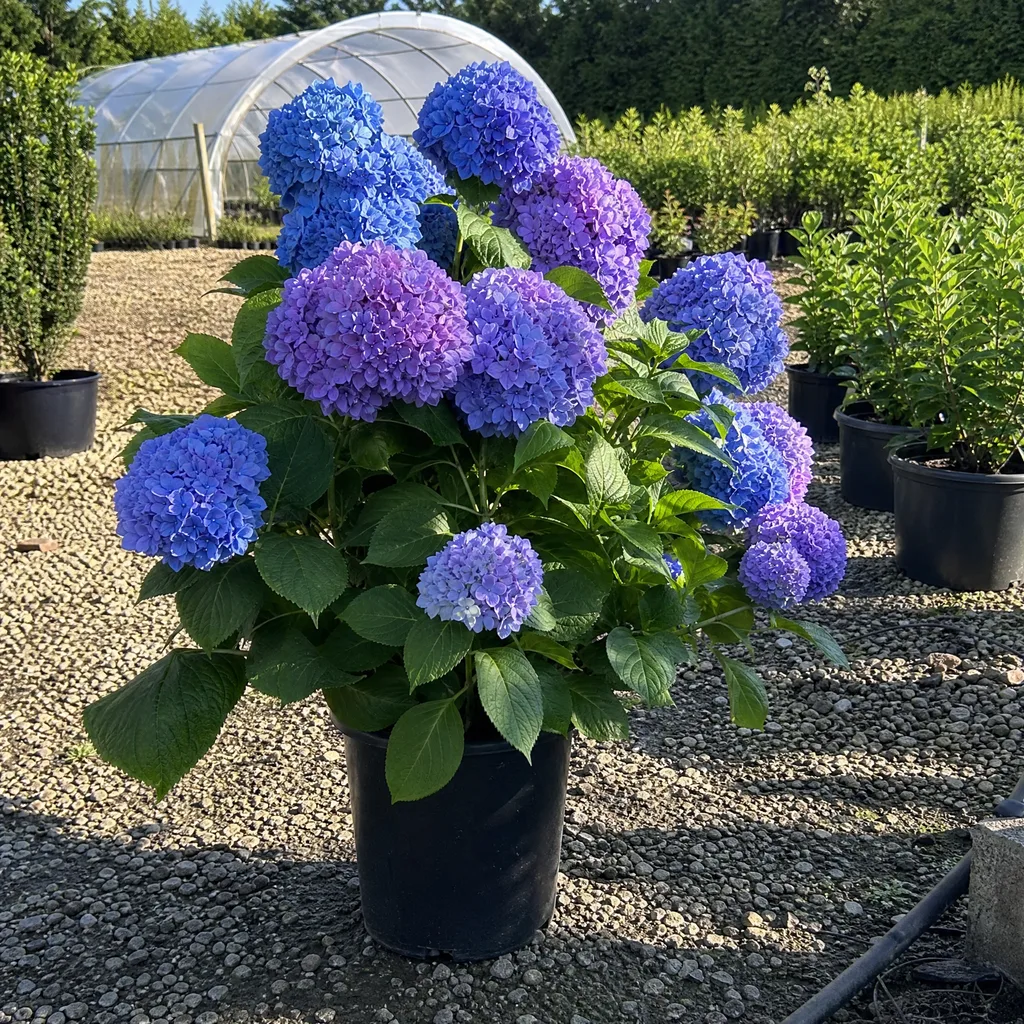
One of the most appealing traits of Big Daddy Hydrangea is its responsiveness to soil pH and fertilizer choice. Blue blooms depend on acidic soil (about pH 5.0 to 5.5) and aluminum availability. Pink blooms occur in alkaline soil (pH 6.5 or above) where aluminum is locked up and unavailable. Our bloom color guide goes deeper on this.
Customers usually ask us whether fertilizer alone will turn a pink plant blue. It won't. Soil pH decides the color, and the products below only help move it. Pantry fixes such as coffee grounds barely change pH, so we skip them.
If you inherit a plant with pink blooms but prefer blue, start by applying aluminum sulfate in late spring and continuing through summer. Results may be gradual over the first season but typically intensify in subsequent years as soil pH shifts and aluminum accumulates in the plant tissue.
If you prefer pink blooms, avoid aluminum sulfate applications and consider a soil pH test. If your soil is already neutral to slightly alkaline, pink blooms should develop naturally. If your soil is quite acidic, garden lime applied in fall can gradually raise pH, but lime works slowly and may take one or more seasons to shift bloom color noticeably.
Common Mistakes and What to Expect
These are the slips we see most often, followed by what a well-fed plant should do for you.
- Over-fertilizing: Excessive fertilizer produces leafy growth at the expense of flowers. Stick to one spring application unless soil is very poor, sandy, or the plant is in a container.
- Fertilizing too late in the season: Feeding after mid-July can stimulate soft new growth that may not harden before winter, increasing frost damage risk and potentially reducing next year's flower production.
- Applying aluminum sulfate to already-blue blooms year after year without testing: Over-application can lead to excessively acidic soil and nutrient imbalances. If blooms are already the desired blue, one or two applications per season may suffice.
- Applying fertilizer directly against the stems: Piling granules or liquid against woody stems can burn tissue or encourage rot. Always maintain a 6-inch buffer around the base.
- Forgetting to water after dry fertilizer application: Granular products need moisture to dissolve and become available to roots. Skipping this step wastes the fertilizer and can increase salt burn risk.
- Ignoring soil moisture: Big Daddy Hydrangea requires consistently moist soil to absorb nutrients effectively. Fertilizing a bone-dry plant is counterproductive. Water thoroughly before and after applying fertilizer.
Avoid those and your plant should respond on a predictable schedule.
You can expect to see early signs of response to spring fertilizing within 2 to 3 weeks, as the plant's foliage deepens and new growth accelerates. Full flowering follows as scheduled in early summer, depending on your region.
If you apply aluminum sulfate for blue blooms, initial color deepening may be subtle the first season but typically becomes more pronounced in the second and third years of consistent application. Bloom size and fullness may also appear to increase with steady feeding, though much of this effect is due to the plant's own fast growth and reliable bud development, which improve as it settles in over its first few seasons.
Conversely, if a plant becomes leggy or produces sparse flowers despite regular watering, fertilizer is unlikely to solve the problem alone. Poor light, excessive shade, or old wood removal by improper pruning are often the real culprits.
If blooms are still missing, our guide on why a Big Daddy may not bloom walks through the other causes.
Quick Reference: Fertilizing Schedule and Rates
This table pulls the schedule, products and rates from the sections above into one place.
| Timing | Product Type | Approximate Rate | Application Notes |
|---|---|---|---|
| Early spring (late Mar–mid Apr) | Balanced (10-10-10) or hydrangea-specific | 1–2 tbsp per foot of height, roughly 1/3–2/3 cup for mature plant | Water soil before and after, work into top 1–2 inches, and avoid stems |
| Early summer (June), optional | Balanced or hydrangea-specific | Half the spring rate, or skip if soil is good | Use only if plant is in container or very sandy soil |
| Late spring–Aug (for blue blooms) | Aluminum sulfate (alum) | 1 tbsp per gallon water, applied every 4–6 weeks | Make 2–3 applications total and continue year after year for sustained color |
| Fall (for pink blooms, if needed) | Garden lime (calcium carbonate) | Follow product label, typically 1–2 lbs per 100 sq ft | Works slowly, so results may take one or more seasons |
For complete care guidance on Big Daddy Hydrangea, see the complete growing guide, which covers planting, pruning, watering, and troubleshooting year-round.
Feeding Big Daddy Through the Years
Feed Big Daddy lightly. Give it nothing at planting, then one balanced dose each early spring, plus a small June top-up only for pots and sandy ground. Stop by mid-July, and let soil pH rather than extra fertilizer set your bloom color. Do that and you get big mopheads in early summer that the bees keep visiting.
Big Daddy Hydrangea
Nursery-grown Big Daddy Hydrangea in sizes from 3 Gallon, shipped to your door.
From $65.85
Shop Now →Our growers watch each plant through the year, from the spring leaf flush to the bud set of late summer, and as a small business with our own farms we grow and sell top-quality shrubs we would happily plant ourselves.