How to Identify Big Daddy Hydrangea by Leaf, Bud and Bloom
Picture a yard with a dozen shrubs and not one plant label. A stranger standing across the lawn would notice size and shape first, then the leaves, and only later the flowers. We saw the same thing in our rows this season: the Big Daddys stood out from the rest of the block before anyone read a tag.
That order is the one to follow when you have inherited or bought an unlabeled hydrangea. Care advice only helps once you know what you have, and a wrong guess sends you toward the wrong pruning and color advice.
This article talks about how to identify Big Daddy hydrangea by leaf, bud and bloom, and answers the questions customers ask us most. Read on to learn how to judge the whole shrub, read the leaves, find the buds on the stem, size up the flower head and tell it from other mopheads.
Spotting Big Daddy Hydrangea From Across the Yard
Start with the widest view you can get. Before you touch a leaf, look at how the plant sits among its neighbors and what kind of presence it has.
Judge Size and Mass First
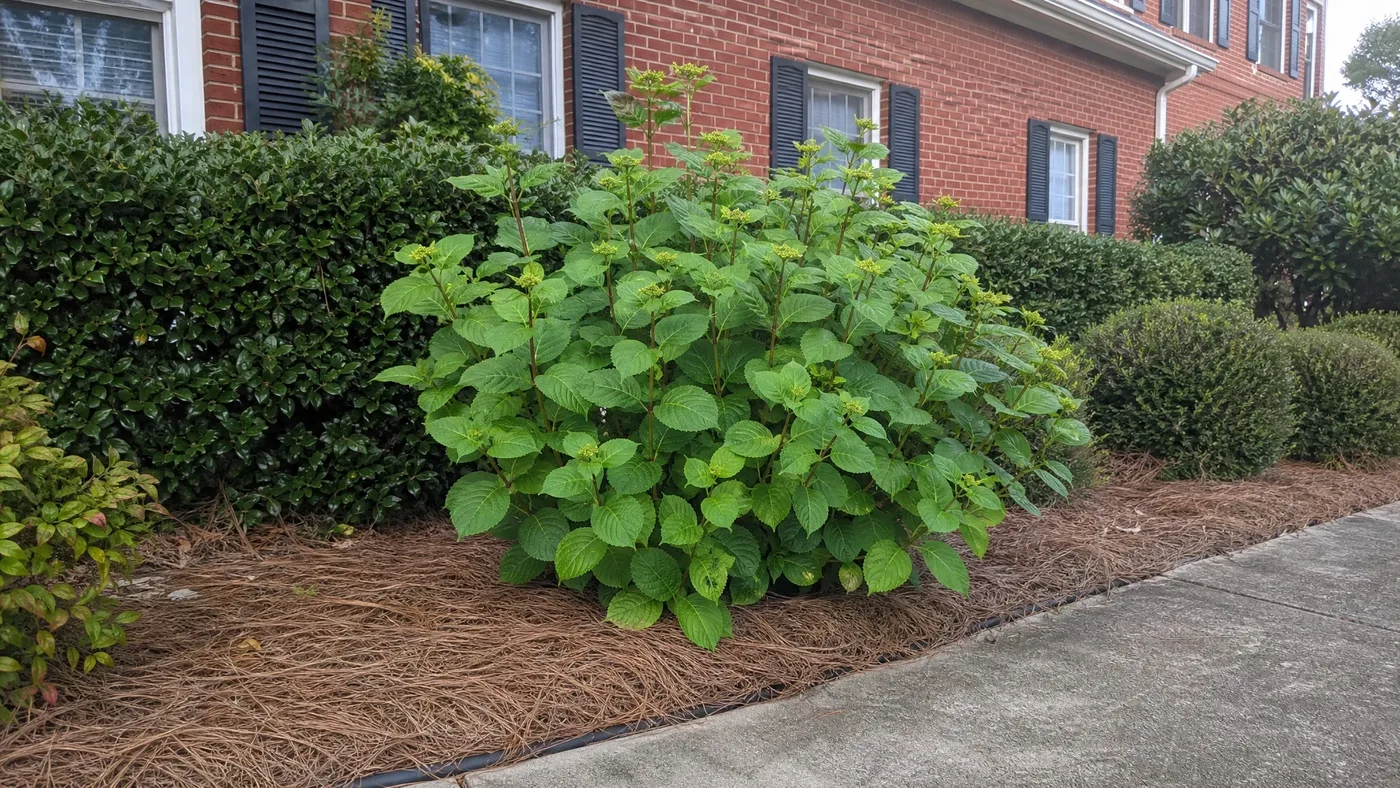
Stand at the far side of the lawn and compare the shrub with the plants around it. Bigleaf hydrangeas in general reach 3 to 6 feet tall and wide at maturity, according to NC State Extension. Big Daddy is a bigleaf, so it falls inside that range, but it reads as the heavy, coarse-textured mass in a mixed bed.
Check how the plant fills its space. A shrub that looks bulky and full, with leaves that catch the light as big flat planes, is a good first candidate. Our guide on how big Big Daddy hydrangea gets at maturity covers the size question in detail, so save it for after you have confirmed the plant.
Size alone can fool you, though. A young plant or one cut back hard last year will be smaller than a mature one, so treat mass as a first impression and not a verdict.
Match the Season to What You See
What you notice depends on the month. In late spring you see a mound of fresh, broad leaves. Bigleaf hydrangea flowers are produced mostly in June and July, and that is when a Big Daddy turns into the largest ball-shaped bloomer in the yard.
In winter the clues change completely. You will see a bare, mounded tangle of stems with fat buds, and that is just as useful for identification. The next sections work from the whole shrub down to the details, so you can follow them in any month.
The Shape and Habit of the Whole Shrub
Habit is the plant's overall growth form. A few terms make the description precise, and each one gives you something to check.
Learn the Habit Terms
Deciduous means the plant drops all its leaves in fall and grows new ones in spring. Multi-stemmed means many stems rise from the base instead of one trunk. Mounded means the outline is a rounded dome, wider than a vase and without a clear top.
The species is a plant that rapidly grows into a multi-stemmed shrub with a rounded habit. Big Daddy matches that description. If your plant has a single woody trunk or a stiff upright shape, it is probably something else.
Walk Around and Check the Stems
Kneel at the base and count how many separate stems come out of the ground. A mature Big Daddy has many, crowded together. Then look at how they carry their load. Stems on a plant in full bloom often lean outward under the weight of the heads, which gives the mound a slightly sprawling edge.
Now feel a stem. Bigleaf hydrangea twigs are hardly woody, and you can feel it: they are thick and soft-cored, not hard like an oak twig. Last year's twigs are light brown, and some of the youngest may be dead at the tips after winter.
Keep your expectations realistic about the first years. A young plant has fewer stems and a looser outline, so judge habit on a plant that has had a few seasons to fill in.
Reading the Leaves of Big Daddy Hydrangea
Leaves are the most reliable clue you can check at any time between spring and fall. Pick one from the middle of a healthy stem, not from a shaded or damaged shoot.
Define What You Are Looking At
Bigleaf hydrangea leaves are opposite, deciduous, simple, ovate to elliptic, serrate, 4 to 8 inches long. Take those words one at a time. Opposite means two leaves leave the stem at the same point, facing each other. Simple means one blade, not a set of leaflets.
Ovate means egg-shaped, widest below the middle. Serrate means the edge has small teeth like a saw. The same source says the leaves are green above and paler below, with raised veins. Turn the leaf over and run a finger along those veins.
Look for Big, Rough and Quilted
All of that describes any bigleaf hydrangea. What sets Big Daddy apart is scale and texture. Its leaves are oversized even against the 4 to 8 inch species range, and they have a thick, quilted look, with the blade puckered between the veins. The surface is rough to the touch, not smooth or glossy.
Think of a quilted blanket: the stitching is the vein, and the puffed squares between are the blade. That is the pattern to look for. Hold a leaf flat on your open hand and see how much of your palm it covers, and compare it with a leaf from a neighboring shrub.
Check several leaves, because new growth and shaded shoots always run smaller. One large, quilted leaf is a hint, but a whole plant of them is the answer.
Where Big Daddy Hydrangea Buds Sit on the Stem
Buds give you a second set of clues, and they are the only ones available when the shrub is bare. Learning where to look takes a minute and works all year.
Find the Nodes
Think of a stem as a ladder, and each rung is a node, the point where a pair of leaves grows. The stretch of stem between two nodes is the internode. After the leaves fall, each node keeps a mark called a leaf scar, and bigleaf hydrangea twigs carry a large one.
Look along last year's stems and find the rungs. A pair of buds sits on opposite sides of each node, just above the scar. Count a few nodes up from the base so you know what ordinary ones look like.
Read the Buds and the Dieback
The buds are large with loose outer scales, and the twigs may show some winter dieback. Plump buds with scales that look slightly open are what you want to see. At the tip of a stem, a fat terminal bud usually holds next summer's flower head.
Dieback is common. Brown, shriveled stem tips are dead wood, but the buds lower down on the same stem are often fine. Scratch the bark gently with a thumbnail. Green underneath means live tissue.
This matters because bigleaf hydrangeas bloom on the previous year's growth. If the buds are there, flowers are coming. Our guide on pruning Big Daddy hydrangea explains how to protect those buds once you know the plant.
What the Flower Head Tells You
The bloom is the most striking clue, and also the easiest one to misread. Look at its size, shape and structure, and leave the color for last.
Measure the Mophead
A mophead is a hydrangea flower cluster shaped like a full, rounded ball. The species baseline is large clusters about 8 inches across, with the large outer flowers sterile. Take a tape measure to a fully open head and compare it with that figure.
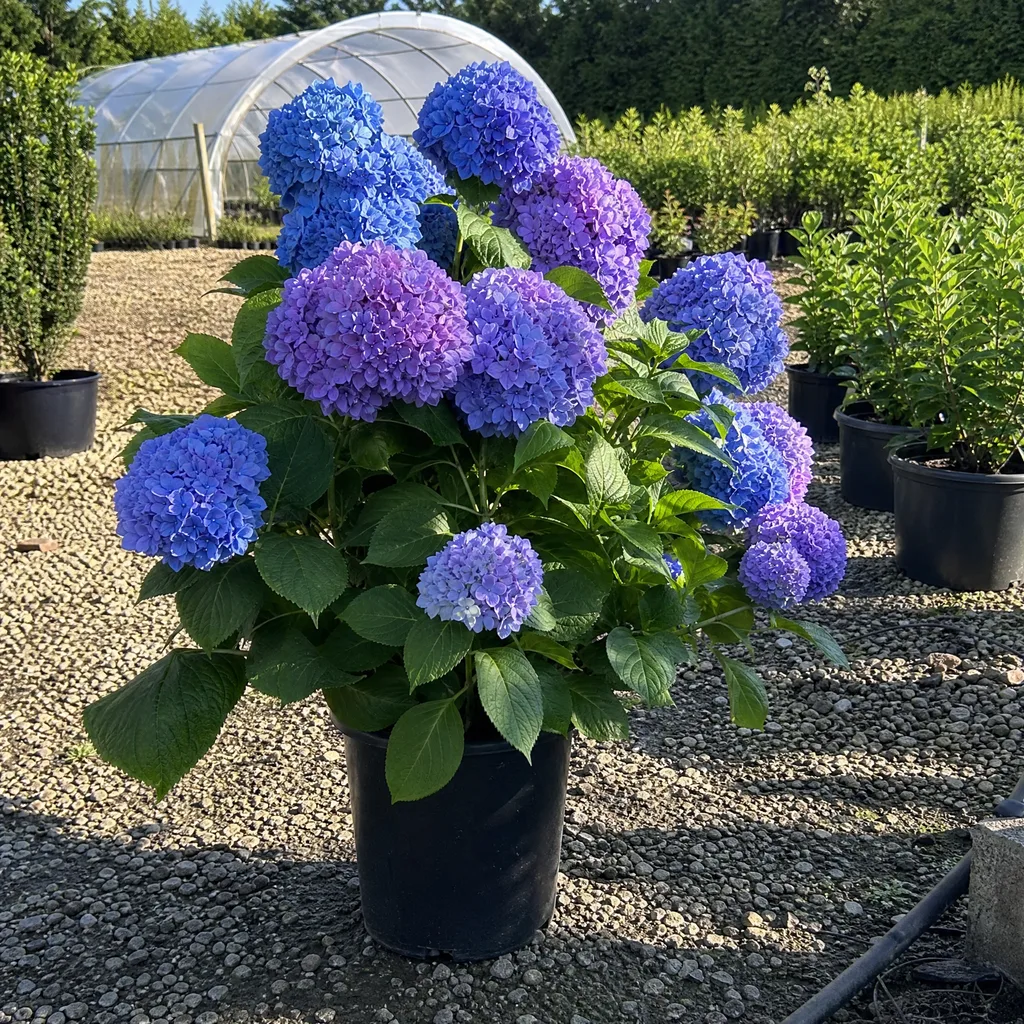
Big Daddy's blooms run oversized beyond that baseline, and a head can look like a cabbage held up against the stem. Look at the individual florets, too. The large, showy ones are the sterile flowers, and on a Big Daddy they pack so tightly that the ball looks solid.
Do Not Lean on Color
Many people try to identify a hydrangea by its flower color. We would not. Color in bigleaf hydrangeas follows soil chemistry, so two plants of the same kind can bloom in different shades. Flowers are blue in relatively acid soil (about soil pH 5.0 to 5.5), and the University of Massachusetts says between pH 5.5 and 6.5 the flowers are purple, or a mixture of blue and pink on the same plant.
So treat color as a soil report, not a name tag. Our Big Daddy bloom color guide explains how to read it.
Telling It Apart From Other Mopheads
Many bigleaf hydrangeas look alike in a photo. In person, a few measurable differences separate Big Daddy from the standard mopheads.
Five Marks to Check
The table below lists the checks that matter most. Use the right-hand column for Nikko Blue, Endless Summer or any similar standard mophead.
| Check | Big Daddy | Standard mophead |
|---|---|---|
| Leaf size | Oversized, thick and quilted | Within the usual 4 to 8 inch range |
| Flower head | Very large, dense ball | Smaller ball nearer the 8 inch baseline |
| Overall mass | Heavy, coarse look | Lighter, finer look |
| Leaf surface | Rough and puckered | Smoother between the veins |
| Flower color | Follows soil pH | Follows soil pH, so no help |
Use the Close Comparisons
Customers usually ask us whether a blue bloom means Nikko Blue. It does not, for the reason above. Put a leaf and a head from each plant next to each other if you can. Our Big Daddy and Nikko Blue comparison goes through the details.
Endless Summer is the other plant people mix up with it. The Big Daddy and Endless Summer comparison shows what separates them. Whichever plant you compare, size is the tiebreaker: the one with the bigger leaves and the bigger head is the Big Daddy.
Confirming an Unlabeled Big Daddy Hydrangea Step by Step
Now put the clues together. Run these checks in order, because each one narrows the answer and the early ones work in any season.
- Step back and look at the whole shrub. Confirm a mounded, multi-stemmed, deciduous plant that looks bulky next to its neighbors.
- Pick a healthy leaf from mid-stem. Check that leaves grow in opposite pairs, have toothed edges and raised veins, and are quilted, rough and oversized.
- Find a node on last year's stem. Look for the leaf scar and the large, loosely scaled buds above it.
- In bloom season, measure the flower head. Look for a very large, dense ball well beyond the 8 inch species baseline.
- Set color aside. Compare the plant with a neighboring standard mophead if you have one.
If your plant passes the leaf and head checks, you can treat it as a Big Daddy. If it matches the bigleaf description but is smaller in both leaf and bloom, it is more likely a standard mophead, and the care advice for each will differ in small ways.
Once you are sure, move on to our Big Daddy hydrangea care guide. If you are still unsure after a full season, photograph a leaf, a bud and a bloom side by side and show them to a local extension office.
Three Checks for Tomorrow Morning
Identification comes down to size at each scale. Tomorrow morning, walk out and run three checks: look at the mounded mass from across the yard, hold one rough, quilted leaf against your palm, and find a fat bud at a node on last year's stem. Add the oversized flower head when summer comes, and you will know.
Big Daddy Hydrangea
Nursery-grown Big Daddy Hydrangea in sizes from 3 Gallon, shipped to your door.
From $65.85
Shop Now →We are a small business with our own farms, growing and selling top-quality shrubs. Our growers watch this plant through the year, from bud swell on bare stems to the heavy heads of midsummer, so we know what a healthy Big Daddy looks like at every stage.