How to Transplant or Divide Big Daddy Hydrangea
Kneel beside your Big Daddy on a cool fall morning and you can smell the soil before the spade goes in, damp and clean, with a faint sweetness of leaf litter. In a few minutes you will feel the weight of a root ball in your hands. That weight is the whole job. The shrub is in the wrong spot, and its roots have to come with it.
This article talks about when to dig, how big a root ball to take, whether Big Daddy can be divided, and what the next bloom season looks like. It answers the questions customers ask us most. Read on to learn how to carry one example shrub from the first spade cut to its second summer, with the numbers worked out at every step. Done well, you lose little. Done badly, you lose a June of flowers.
Meet the Six-Year-Old Big Daddy Hydrangea We Are Moving
Every number in this guide follows one example shrub, so you can swap in your own measurements as you read.
The Shrub We Are Digging
Here is the plant on the spade side of the fence.
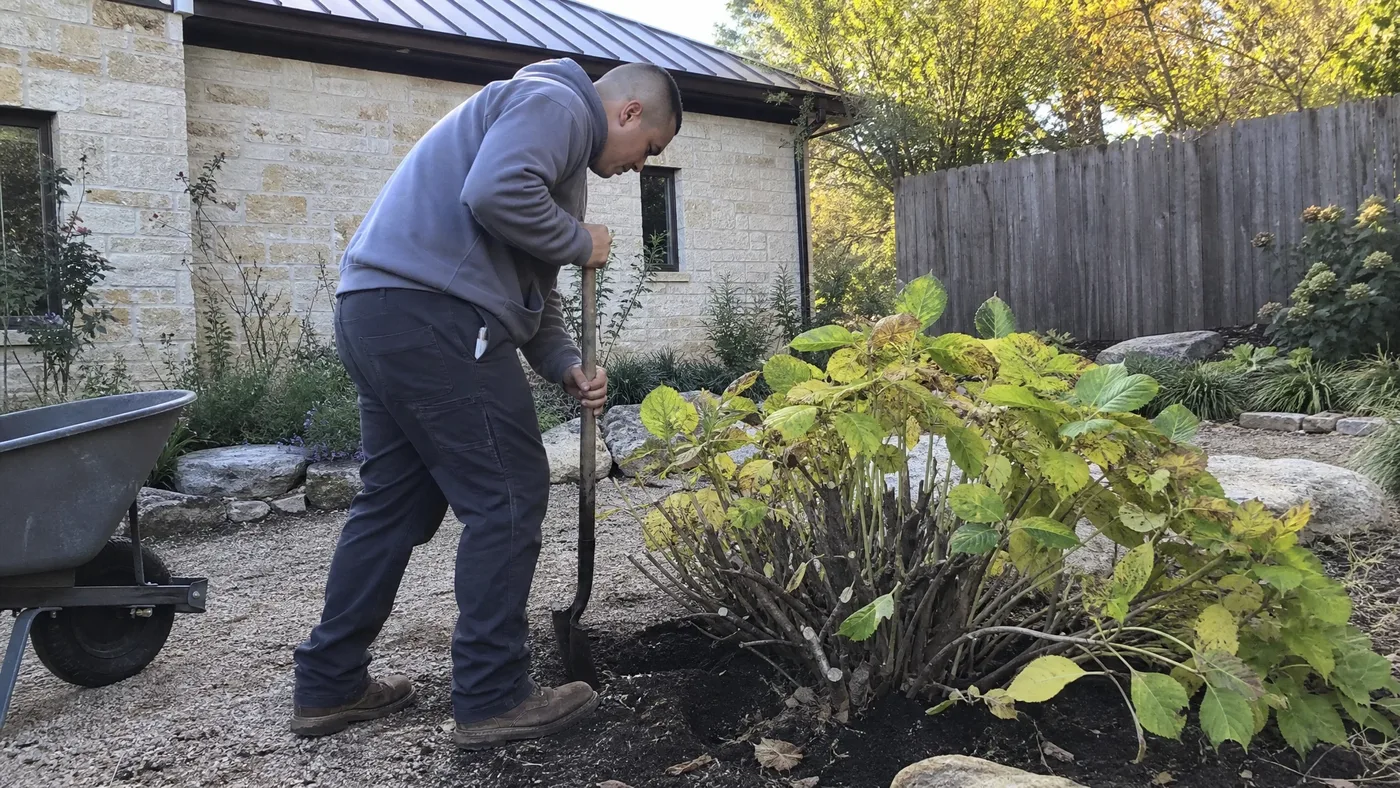
Our example Big Daddy has been in the ground six years. It stands about 3½ feet tall and 40 inches across, inside the 3 to 6 feet the species reaches. It has filled out into a rounded, multi-stemmed mound. Yours may be larger, and every step below scales up.
It was planted tight against a fence on the west side, where afternoon sun now reaches it. Extension guidance for the species is to protect it from afternoon sun, and by midsummer the leaf edges curl and brown. The new home is a bed on the east side of the house, with morning light and shade after noon.
Why Moving Beats Leaving It
Staying put costs this shrub more than moving does, but the move has one real price.
Scorched leaves and a plant that sulks every August will not fix themselves, and a mature Big Daddy only gets wider. The price is that its root system is broad by now and its flower buds ride on last year's wood, so a careless move can cost you a season of bloom. For the background, read how Big Daddy carries its buds on old wood. The rest of this guide is about keeping that price low.
Picking a Cool Fall Day After Leaf Drop
The calendar matters less than three things you can check yourself: whether the leaves are gone, how the air feels, and how wet the soil is.
Wait for Dormancy
Dormancy is the signal, and the leaves tell you when it has arrived.
The best time to transplant hydrangea is when they are dormant, after all leaves have been shed. Our example shrub waits until the last leaf has dropped. With no canopy, the plant loses almost no water, so the roots you cut have little to supply. Digging a Big Daddy in full leaf is the quickest route to a wilted, sulking plant.
Check the Air and the Soil
Choose a cool, overcast day if you can, because cool air keeps the exposed root ball from drying while it waits.
Two or three days earlier, soak the soil around the shrub slowly and deeply. Moist soil clings to roots and holds the ball together. Dust-dry soil falls away in the hole, and soggy soil slumps inside the burlap. A good test is a handful that squeezes into a loose clump and breaks apart when you poke it.
Fall or Spring?
Both seasons work, and the choice depends on how much time you have.
Oregon State's extension says large hydrangea specimens are best moved in spring or fall. We favor fall for Big Daddy because the tops are asleep and the soil is still easy to work. If you must wait for spring, the Illinois extension suggests you root prune in the fall and transplant in the spring. Cut the circle now, leave the shrub standing, and lift it months later. Across zones 6 to 9 the freeze dates vary widely, so ask your local extension service when your ground typically locks up.
Digging a 20-Inch Root Ball Around Big Daddy Hydrangea
Now comes the number that decides everything: how much root to take.
Working Out the Size
Iowa State gives a rule you can do with a tape measure and a little arithmetic.
It says the radius of the root ball for deciduous shrubs should be about one-half the distance from the dripline to the center. Our shrub is 40 inches across, so the dripline sits 20 inches from the center. Half of that is a 10-inch radius. The table lays out the example numbers.
| Measurement | Example shrub |
|---|---|
| Spread of the shrub | 40 inches |
| Dripline to center | 20 inches |
| Root ball radius | 10 inches |
| Root ball diameter | 20 inches |
That stays under 2 feet, the point where the same page warns root balls become extremely heavy and usually need mechanical equipment. A Big Daddy 5 feet wide would call for a ball of about 30 inches, so line up a machine or strong helpers. One of the most common questions we get is whether a bigger ball is better. UConn's advice is to dig as much of the root ball as possible, so if the roots run past your line, keep going.
Cutting, Wrapping and Lifting
Work through these steps in order, and have the burlap and twine laid out before you cut.
- Tie the canes loosely with soft twine so they do not snap, and mark the side facing north so you can replant it the same way.
- Push a sharp spade straight down around the circle, 10 inches out from the center of the shrub.
- Dig a trench just outside that line, then undercut the ball at an angle until it frees from the soil below.
- Slide burlap under one side, tip the ball, pull the cloth through, and tie it snug around the ball.
- Lift with two people, holding the burlap and the ball, never the stems.
Can Big Daddy Hydrangea Be Divided at All?
Customers ask this nearly every fall, and the honest answer has two parts: where it splits, and what each piece will do.
Where a Clump Splits Cleanly
Big Daddy grows into a multi-stemmed shrub, so an older plant often has outer stems with roots of their own.
Those outer groups are the only natural dividing lines. Common advice says to push a spade through the middle and call it two plants. We would not. That cut goes through the crown and strips buds along with roots.
After lifting our example, look at its edge for a group of a few stems with a mass of fine roots attached. Cut it free with a clean knife or sharp spade, keeping those roots with it.
What Each Piece Will Do
Expect the two pieces to behave very differently in their first year.
The big piece keeps most of its stems and roots, so it keeps most of its chance at June flowers. The offshoot has few stems and little root, so plan on no bloom the first year and a slow build after that. Flower buds sit on last year's wood, and any stem you remove takes its buds with it.
Pot the offshoot, keep it in part shade, and water it like a new planting. If your real goal is more plants, propagating Big Daddy from cuttings costs the parent shrub far less.
Settling Big Daddy Hydrangea Into Its New Hole
The new hole should be ready before you lift the old shrub, so the roots never sit exposed.
Dig the Hole First
Size the hole to the ball you are about to carry.
Make it wider than the 20-inch ball so loosened soil surrounds the roots, and no deeper than the ball is tall. Set the ball on firm soil so it cannot settle. The top of the ball should sit level with the surrounding ground. Our planting guide covers new plants and soil prep, and the same hole rules apply here. Cut away the burlap from the top and sides, and remove any synthetic cloth completely. Backfill with the soil you dug out and firm it gently.
Water and Mulch
Water is the one task you cannot skip in the first weeks.
Water thoroughly right after planting. UConn says to keep watering regularly through the first two summers, and that deep, less frequent watering beats a daily sprinkle. For timing by weather, see our watering guide. Spread shredded bark over the root zone, keeping it off the stems, to hold moisture through the cold months.
First Weeks Checklist
Run through this short list every week or two until the ground freezes.
- Check the soil beside the root ball with a finger and water deeply only when it feels dry.
- Remove the twine from the canes once the shrub is in place so it cannot cut into the stems.
- Leave the pruners in the shed, because every stem you cut now removes buds for next June.
- Hold off fertilizer until you see new growth in spring.
- Top up the mulch after heavy rain washes it thin.
What Big Daddy Hydrangea Gives You the Following June
Expect a quiet first June, and know that quiet is not failure.
Fewer Heads Than Before
June is when you find out what the move cost.
Virginia Tech says hydrangea flowers are mostly produced in June and July. The Arkansas extension points out that flowers are set and you want the plant as intact as possible if you want blooms in the first year. Because we kept the ball whole and the canes unpruned, expect noticeably fewer heads than last year, perhaps only a handful.
Slow Leaf-Out
Your neighbors' hydrangeas will leaf out first, and yours may lag behind them.
The leaves that do come are often smaller and a little pale, and the mound looks thin. Do not dig it up in a panic. Scratch a cane with your thumbnail, and green under the bark means it is alive. Give it until early summer before you judge. If the soil pH differs from the old bed, the color of those first heads may also shift. Acid soil around pH 5.0 to 5.5 gives blue, and higher pH leans pink.
Normal or Worrying
Most of what you will see is normal, and a few signs need action.
Normal: late leaves, small leaves, afternoon droop on hot days that recovers by evening, and few or no flowers. Worrying: canes that stay brown and brittle through early summer, leaves that stay wilted after deep watering, or a ball that has sunk into standing water. Fix the water first, then wait.
One Moved Shrub, Rooted in by Year Two
Follow the same shrub into its second year, and you can see when it counts as established.
The Second Summer
By the second summer, our example is leafing out on time beside its neighbors.
Keep up the deep watering, since the first two summers are the period that matters. Prune only right after flowering, as extension guidance for old-wood hydrangeas says, and our pruning guide has the details. A light hand is best this year.
Signs It Is Established
Look for a handful of signs rather than a date on the calendar.
The leaves are full size and deep green. New canes rise from the base. The June heads return to the size you remember, and the shrub wilts only on the hottest afternoons. In our rows, that last sign is what tells us a moved plant has settled. At that point the root system has grown well past the original 20-inch ball.
The Shrub That Forgot It Was Moved
Move Big Daddy after the leaves drop, take a ball at least half the distance from dripline to center in radius, divide only where stems have their own roots, and keep the soil evenly moist through two summers. Leave the pruners alone the first winter, and accept a lean first June.
Big Daddy Hydrangea
Nursery-grown Big Daddy Hydrangea in sizes from 3 Gallon, shipped to your door.
From $65.85
Shop Now →Picture that same shrub in its second summer, at full leaf, heavy heads nodding over the bed, bees working the blooms in the morning light, the move forgotten. We are a small business with our own farms, and we grow and sell top-quality hydrangeas. Our growers watch Big Daddy through the year, from bud swell in spring to leaf drop in fall, because that last signal is the one that tells you the move can begin.